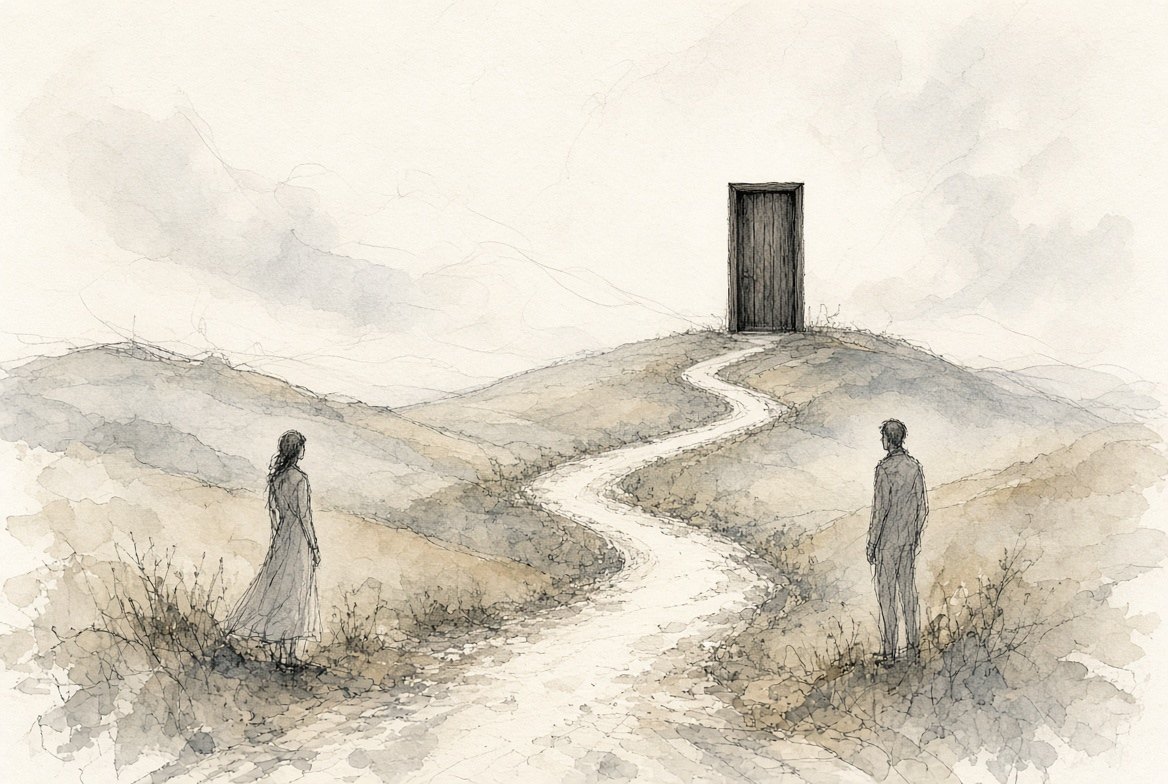
Coldplay's "The Scientist" is a lament, and like the great laments of Scripture, it is not finally a song of despair. It is a song of remembering. Its narrator stands in the wreckage of a love he let cool, and his one desire is to go back to the start.
That longing is more than a breakup ballad. Human love, at its best, is a shadow of a larger love: the relationship between man and God. The pattern the song describes is the same in both. Love begins in wonder and self-forgetting. It matures into routine. Routine tempts us to calculate. And the only way back is not forward through better reasoning, but back through memory, to the love we had at first.
Going back to the start cannot be done by turning back the clock. It can be done by choosing to remember, and by acting on what we remember.
The Shadow and the Substance
Scripture does not treat marriage as a mere metaphor for faith. It treats marriage as an image God built into creation so that we could understand Him. The prophets speak of Israel as a bride. The Song of Songs has been read for millennia as the soul's longing for God. Paul calls the union of husband and wife a mystery that points to Messiah and His people.
If human love is the shadow, the divine relationship is the substance. That means the lessons run in both directions. What we learn in the slow work of a marriage teaches us how we treat God. And what God shows us of His faithfulness teaches us how to love one another.
So when the narrator of "The Scientist" confesses that he failed to see what he had, he speaks for more than the jilted lover. He speaks for every believer who once burned with devotion and woke one day to find the fire had gone low.
How First Love Cools
New love is accepting, forgiving, excited and present. We give ourselves to it without counting. Reason does not vanish, but it bows; we sacrifice our own convenience gladly because the beloved fills our sight. In that season we see clearly what matters, even if we see little else.
Then love becomes ordinary. Nothing is wrong, exactly. But the routine no longer overwhelms the self, and selfishness returns to the room. We begin, like the song's scientist, to reason about the relationship. We weigh cost against benefit. We remember what we gave during the falling and start to wonder whether we gave too much. Quietly, we take some of it back.
Faith follows the same path. The new believer prays without being told and gives without being asked. Years later, the same believer may be keeping a ledger: what has obedience cost me, and what has God given in return? The scientist's error is to apply calculation to something that was never a transaction. Love that is reduced to a ledger does not end in a dramatic break. It simply cools, one reasonable withdrawal at a time.
There is a hard truth here. We cannot simply return to the falling. Part of what made new love easy was that it rewarded us at once; every sacrifice came back as joy. Mature love has no such rush to lean on. Its sacrifices must be chosen. That is harder than falling in love, and it is worth more.
Lament Remembers
Biblical lament has a shape. It begins in honest grief, refuses to pretend that all is well, and then turns. The turn almost always comes through memory.
The book of Lamentations is written over the ruins of Jerusalem. Its third chapter descends through affliction and bitterness until the poet stops and says, "This I recall to my mind, therefore have I hope" (Lamentations 3:21). What he recalls is that God's compassions "are new every morning: great is thy faithfulness" (3:23). The word is new. In the middle of ruin, remembering restores newness.
Psalm 77 follows the same arc. The psalmist cannot sleep and wonders whether God's mercy is gone forever. Then he resolves, "I will remember the works of the LORD: surely I will remember thy wonders of old" (77:11). Nothing in his situation has changed yet. What has changed is where he is looking.
"The Scientist" stands in this tradition, whether its writer intended it or not. It is honest about loss. It does not offer excuses. And its refrain reaches backward, to the beginning, as the only place hope can be found. The lament is hopeful precisely because it remembers.
Remembering Is a Choice
In Scripture, remembering is not nostalgia. It is something you do. Israel remembers the Exodus by keeping Passover, eating the meal and telling the story again (Exodus 12:14). Messiah gives His followers bread and wine with the words "this do in remembrance of me" (Luke 22:19). Memory is kept alive by action, and action brings the past into the present.
The clearest statement of this comes in the letter to the church at Ephesus. It was a faithful church, hardworking and doctrinally sound. Yet the charge against it is simple: "thou hast left thy first love." The remedy is three steps: "Remember therefore from whence thou art fallen, and repent, and do the first works" (Revelation 2:4–5). Remember, turn, act. The church is not told to feel its old feelings. It is told to do what it did at first, trusting that the love will follow the deeds.
That is how first love is sustained in any relationship. We cannot will the rush of falling back into being. But we can remember what we did when we were falling: the attention, the patience, the gifts given without counting, the forgiveness offered before it was asked. And we can choose to do those things again, now, with open eyes. This is the real meaning of going back to the start. It is not a return to innocence. It is a return to selflessness, chosen by someone who knows exactly what it costs.
The God Who Also Remembers
The song ends without an answer. The narrator confesses, longs and repeats his plea, but we never hear whether the one he wronged will take him back. That silence is what makes it a lament rather than a love song.
Here the shadow and the substance part ways, and the substance is better. In the divine relationship, we are not the only ones remembering. Through Jeremiah, God says to a faithless people, "I remember thee, the kindness of thy youth, the love of thine espousals, when thou wentest after me in the wilderness" (Jeremiah 2:2). God holds the memory of our first love even when we have lost it.
And He does not wait for us to find our way back alone. In Hosea, the wronged husband is God Himself, and His response to betrayal is not a ledger but a courtship: "I will allure her, and bring her into the wilderness, and speak comfortably unto her... and she shall sing there, as in the days of her youth" (Hosea 2:14–15). He brings her back to the start.
That is the hope hidden inside every honest lament. The scientist could not reason his way back to love, and neither can we. But we can remember. And when we remember, and do the first works again, we find that the One we left has been waiting at the beginning all along, ready to make His compassions new every morning.